


Case Study - Hellblade 2 : Senuas Saga - MoCap Cinematics

In January 2023 I started on the highest budget project of my career, and it wasn't something that I thought was on my immediate career roadmap. Ninja Theory brought me in to record sync audio on their mocap stage for cinematic sequences of their upcoming game release, Hellblade 2: Senuas Saga. It was an honour to join an award winning studio, with a Bafta for best audio, to hopefully bring the mocap performances to life with true sync audio.
With no prior experience of working directly on games, although some experience working with game studios on other games adjacent content, it was clear to me that this would be a slightly different experience to my usual work. We settled on a workflow of just radio mics, with DPA 4061 lav mics mounted to the helmets of the facial capture system. The team already had a number of Lectrosonics radios and DPA 4061 mics, so we used what we had.
THE RIG
Headcam mics
The helmet rig is just about the most simple possible rig to allow a solo operator to rig up to 6 people relatively quickly.
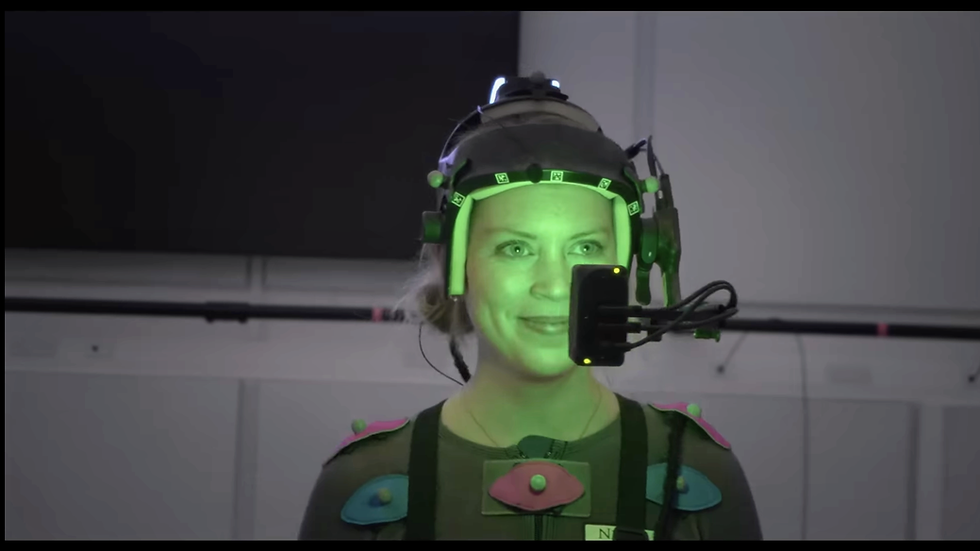
Here's Mel, playing Senua, on the volume for the day we recorded for the GDC 2023 Epic Games Unreal Engine demo.
You can see the mic on the brim of the helmet; a great position for a mic.
Recorder, mixer & radio system(s)

The main system on the desk was built around a Sound Devices MixPre 10T, Lectrosonics D2 DSQD and a Lectrosonics VR, which were all owned by the studio. We augmented that with a Wisycom MCR42, and ran all our antenna connections through an Audio Wireless DADM 226 DT antenna distribution system and the LPDA-DIV antenna to improve RF reliability (more on that later).
I added a nice little keyboard for data entry into the MixPre, and a Korg NanoKontrol2 to help get better hands on control over the main functions of the MixPre and help to build a solid reference mix for each take. We also made use of Sound Devices Wingman app to get a better view over metadata entries.
The MixPre also doubled as an interface for some playback duties for some intricate scenes where we also made use of a Sennheiser IEM system to feed pre-recorded or read lines to Melina to perform against.
A quick note on MixPre's and using them as interfaces in this way: When connecting and disconnecting a MixPre over USB to a PC or Mac, make sure to check the sample rate before you record again as it can and will automatically change to the PC systems default sample rate, potentially leaving you in 44.1kHz rather than the 48kHz you would typically record dialogue at.
To integrate radio comms into the system we made use of a Smyles Combiner to get audio and comms feed into the headphones.
Finally, I also made use of a single shotgun mic mounted up where I was in order to pick up a scratch track and slate calls away from the radio mics. I started with one of the audio teams Sennheiser MKH 416 and later switched out to my Sanken CS-3e as the audio team needed to use the 416 for recording other stuff periodically.
CHALLENGES
While the rig was straightforward and the rest of the system was easy to operate there were a few unusual challenges that you definitely wouldn't experience on a more traditional film set.
Hostile RF environment
The most prominent early challenge was with what seemed like RF spikes in the performance space, a problem confirmed by the motion capture techs on the stage who have had their own issues with Ambient Timecode Network products running for syncing the headcams.
There were a number of RF systems in place in the studio, and places for potential RF leakage:
- For facial capture, each of the five camera systems is a self contained PC; with dual camera recording, transmitting live feeds over 5GHz WiFi, receiving a Timecode feed from the wireless Ambient Clockit Network. This alone would probably be a significant RF source, even if none of the intentional RF was close to our UK 606 band kit there's always possibility for strange RF harmonics popping up every now and again.
- The mocap system itself is a 360 degree camera system (infra red) that is made up of 50 - 60 cameras, each providing a live feed to a PC over ethernet.
- Couple that with video switchers for the four projectors and the large LED screen used for reference and the 5 or so other PC's being used by the crew and it all adds up to a challenging spot for critical audio over RF.
We found that our Lectrosonics Hybrid Digital radios would just splat and pop while moving around the stage. We took several steps to prevent this from happening while we were shooting. Firstly all of our DPA lavs were sent to be re-terminated with Lectrosonics TA5 connectors instead of using MicroDot and adapters to ensure there were no problems with the MicroDot connectors (which was a problem that I'd read about on Lectrosonics user groups). Secondly we took the decision to rent in more digital packs. Our Lectrosonics DBu transmitters had been very reliable so we went with two more of those. Thirdly we ran all of our receivers through a filtered RF distribution unit (Audio Wireless DADM 226 DT) and also through a diversity antenna system (Audio Wireless Diversity Fin). These steps massively improved the RF performance, reducing dropouts and increasing reliability of all of the remaining systems.
Limitations of the Mix Pre?
The MixPre range from Sound Devices is a really great recorder. Quite excellent preamps and line level inputs, and a versatile Class Compliant USB interface mean it can cover a lot of useful duties. I actually really enjoyed using it in conjunction with a small control surface and would recommend this range for more compact location recording solutions.
It comes with the usual compromises. The app control is only ok, and the screen is really, really small for data input.
Huge thanks to Ninja Theory and all of their in-house team for bringing me on board and making their studio feel like a second home for a significant portion of 2023. I wasn't sure how it would go when I started but by the end I felt like I wanted to be the go to sound person for video game cinematic mo-cap recording. If anyone is looking for an experienced sound recordist who also has significant experience working alongside video games and motion capture technology then please get in touch.


Comments